
Why Building Occupants Don’t Report Faults: Choosing a CMMS that C.A.R.Es
Ask any facilities manager how many fault reports they received last month, then ask how many faults they think actually happened. The gap between those two numbers is often where the real problem lies. It is not simply the maintenance backlog, but the issues that were noticed by building occupants and never formally reported in the first place.
A flickering light in a stairwell, a loose handrail, or an air-conditioning unit dripping onto a desk may be noticed several times before anyone reports it. In many cases, the first report comes through an informal conversation with a security guard, a message to the property manager, or a chat through WhatsApp or Viber. Unless these reports make their way into a proper facilities management system, maintenance teams may never have a complete picture of what is happening across the building.
The facilities management industry has spent years improving the systems used to address this problem. Modern Computerized Maintenance Management Systems (CMMS) now offer asset registries, mobile applications, QR-code reporting, self-service portals, work-order tracking, and increasingly sophisticated analytics.
These capabilities can significantly improve the work of facilities and maintenance teams. However, there is another part of the process that is sometimes overlooked: the person reporting the problem.
For a tenant, employee, resident, or visitor who may only need to report a facility issue occasionally, downloading a dedicated application, creating an account, logging in, and learning a new system can be enough friction to discourage reporting altogether. When reporting is inconvenient, small problems can remain invisible until they develop into larger, more expensive, or potentially unsafe issues.
This challenge is particularly relevant for facilities teams in the Philippines. As areas such as Makati, Bonifacio Global City, and Ortigas continue to accommodate increasingly dense commercial and mixed-use developments, facilities teams are responsible for environments with large numbers of occupants and numerous communication channels. Malls and other public-facing facilities also serve thousands of visitors who cannot realistically be expected to download a dedicated application just to report a facility concern. In hospitals, manufacturing facilities, and industrial estates, meanwhile, an unreported issue may also carry operational, compliance, or safety consequences.
Choosing an FM Platform that C.A.R.Es
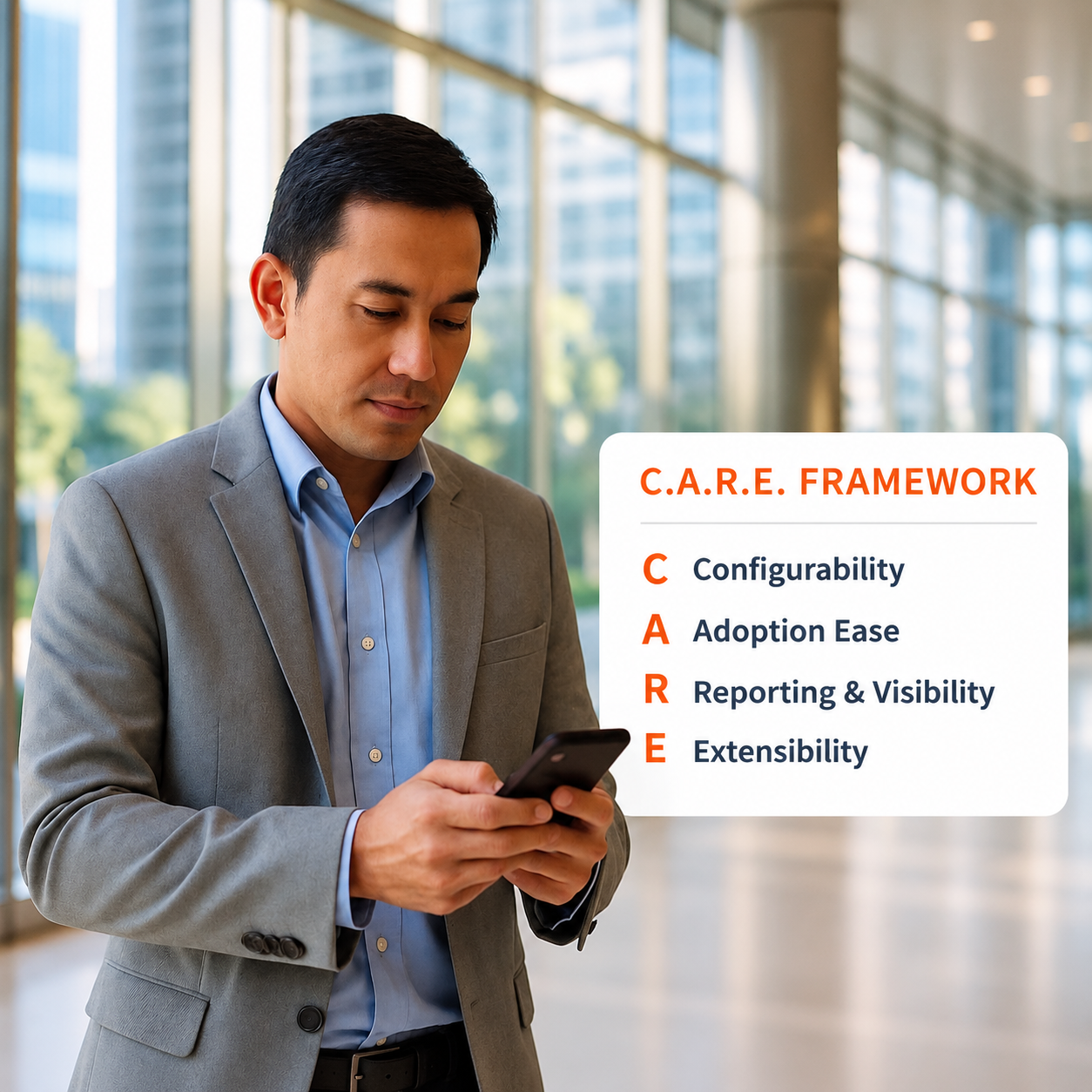
When evaluating facilities management technology, FacilityBot proposes a simple framework built around four areas: Configurability, Adoption Ease, Reporting and Visibility, and Extensibility, or C.A.R.E.
Configurability refers to how easily a platform can adapt to the actual processes of an organization. Facilities operate differently depending on their type, occupants, regulatory requirements, and operating model. A hospital’s permit-to-work process, for example, may be very different from the workflow used to handle tenant concerns in a shopping mall. An effective FM platform should therefore allow workflows, forms, approval processes, and escalation rules to be configured without requiring extensive custom development.
Adoption Ease considers how simple the system is for the people expected to use it. For fault reporting, one important question is whether occupants can report an issue without downloading another application or creating another account. Reducing these barriers can make it significantly easier for facilities teams to capture issues that might otherwise remain unreported.
One approach is messaging-first fault reporting. Instead of requiring occupants to use a dedicated application, reporting can take place through communication platforms they already use, such as WhatsApp, Viber, Microsoft Teams, Telegram, Slack, or Line.
FacilityBot was developed around this approach, allowing occupants to report issues through existing messaging channels without requiring a separate download or login. According to FacilityBot, buildings using its platform have collectively logged more than one million resolved fault reports. The company has observed that reporting volumes tend to increase when facilities move toward messaging-based workflows because the process becomes easier for occupants.
Reporting and Visibility is the third consideration. Collecting tickets is useful, but facilities managers also need to understand what those tickets are telling them. Real-time dashboards and trend analysis can help teams identify recurring problems, monitor response times, track compliance requirements, and understand where resources may need to be allocated.
Instead of viewing maintenance requests as isolated incidents, better reporting allows facilities leaders to identify patterns across a building or an entire portfolio.
Finally, Extensibility looks at how the system can grow with the organization’s requirements. This may include artificial intelligence, Internet of Things (IoT) sensors, single sign-on, and integrations with collaboration platforms and other existing systems.
While these technologies can offer significant benefits, they are most effective when the fundamentals are already in place. Advanced technology cannot compensate for a reporting system that occupants find difficult to use or for maintenance information that facilities teams cannot easily interpret.
Fault Reporting Is Only Half of the Picture
Reactive fault reporting addresses problems that someone has already noticed. Preventive maintenance addresses the issues that may not yet be visible to occupants.
A fire extinguisher approaching its inspection date, a chiller requiring scheduled servicing, or an equipment checklist that needs to be completed before a technician ends a shift may never generate an occupant complaint. These tasks still need to be managed systematically.
For this reason, fault reporting and preventive maintenance should ideally form part of the same facilities management environment. Technicians responding to reported faults and technicians carrying out scheduled inspections are performing closely related activities. Requiring separate systems, processes, or logins can create additional administrative work and reduce adoption among maintenance teams themselves.
Digital, mobile-first preventive maintenance checklists can help address this by allowing tasks to be assigned, tracked, completed, and time-stamped within the same system. The resulting records also provide an important audit trail, particularly for regulated environments such as healthcare and manufacturing facilities.
Where AI and IoT Fit into Facilities Management
Once the fundamentals of reporting, adoption, and visibility are established, newer technologies can further improve how facilities are managed.
Artificial intelligence can assist facilities teams in analyzing information and generating customized dashboards. IoT devices such as temperature, water-leak, and vibration sensors can automatically identify abnormal conditions and generate alerts or work orders before an occupant notices a problem. Integrations with platforms such as Microsoft Teams or Slack can also allow facilities management processes to become part of tools that employees and tenants already use.
These technologies can gradually shift facilities management from being primarily reactive toward a more proactive and predictive operating model.
However, technology works best when it builds on strong processes. A sensor that automatically generates a maintenance ticket has limited value if the resulting ticket is not properly monitored or acted upon. In the same way, an advanced CMMS cannot provide a complete picture of a facility if occupants are reluctant to report what they see.
The goal, therefore, should not simply be to implement more technology. It should be to make facilities management easier to participate in, easier to monitor, and easier to improve.
Continuing the Conversation at NFMS 2026
FacilityBot has spent the past seven years developing its approach to messaging-first fault reporting, configurable preventive maintenance, and real-time facilities dashboards. Its platform currently operates across more than 10 million square meters of facilities and serves more than 60,000 active users across the region.
FacilityBot will be participating in the National Facilities Management Summit 2026 (NFMS 2026) on October 15, 2026, at SPACE at One Ayala, Makati City.
Facilities professionals interested in improving fault reporting, preventive maintenance, and the use of technology in their facilities can meet the FacilityBot team at the summit and learn more about how the C.A.R.E. framework can be applied to their own buildings and operations.